TOURDATA
Museumsplatz 5, 3500 Krems an der Donau
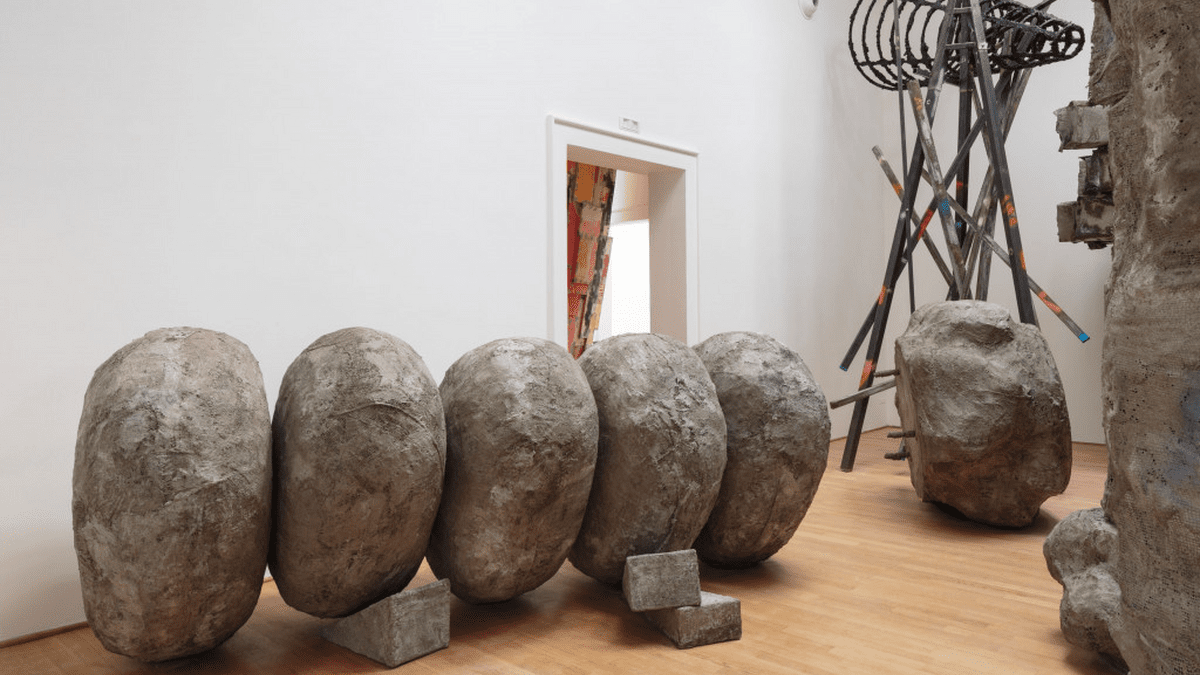
Phyllida Barlow (1944–2023) is considered one of the most prominent sculptors in contemporary art. Her powerful, space-consuming installations attract international attention. A significant feature is her radically abstract language of form. The often unwieldy objects create a dystopian environment through their interplay. Barlow uses simple materials such as wood, plaster, gauze bandages, plastic, or polyurethane. The surfaces are mostly painted and appear to be worked in a painterly manner. Forms appear broken, folded, stacked, or piled up—always in the tension between monumentality and improvised expression.
Ruined Cities
Barlow's installations come together to form dense, multilayered environments that resemble their own landscapes. Large, massive constructions push into passages, block sightlines, and create a sense of instability and confinement. They evoke associations with urban ruins. In many of Barlow's works, her memories of war-torn post-war London resonate.
Biennale di Venezia and Tate Britain
Barlow gained particular recognition in 2017 for her contribution to the British Pavilion at the Biennale di Venezia, where she redefined the building's space with massive, sometimes obstructive structures. This late international success, complemented by major solo presentations, such as at Tate Britain in 2014, and comprehensive retrospectives, makes her significance visible beyond the national framework.
First Museum Exhibition in Austria
Phyllida Barlow's artistic work is characterized by a constant willingness to experiment, material exploration, and spatial relevance, setting sustainable impulses for current forms of sculptural design. With the exhibition at Kunsthalle Krems, Barlow's oeuvre is presented for the first time in Austria in a museum retrospective. The exhibition brings together large-scale installations, individual sculptures, and models (maquettes) alongside paintings and works on paper.