Heilbronn
Berliner Platz 1, 74072 Heilbronn
The life of an artist continues to hold an unbroken fascination. After all, it stands for freedom, creativity, an unbridled zest for life, and deep emotion. But Giacomo Puccini explored just how much it can also be accompanied by existential fears and constant ups and downs in his wonderful opera *La Bohème*.
The life of an artist continues to hold an unbroken fascination. After all, it stands for freedom, creativity, an unbridled zest for life, and deep emotion. Yet Giacomo Puccini explored just how much it can also be accompanied by existential fears and constant ups and downs in his wonderful opera "La Bohème." It was based on Henri Murger’s novel “Scènes de la vie de bohème,” which immediately captivated Puccini. For he recognized himself in the protagonist, having also experienced such impoverished student years in Milan. “The book contained everything I sought and loved: the freshness, the youth, the passion, the joy, the tears shed in silence, love with its joys and sorrows. That is humanity, that is feeling, that is the heart,” Puccini raved. He created an opera of heart-wrenching beauty and exceptional musicality.
It transports us to the Parisian artistic scene of the late 19th century. In the attic of a house, the writer Rodolfo, the painter Marcello, the philosopher Colline, and the musician Schaunard live together in great financial uncertainty. It is Christmas, their attic is cold, and they are hungry as well. Fortunately, the musician returns from a concert with wine, firewood, and a little money, which he plans to spend on this Christmas Day with his friends in the Latin Quarter. While the other three are already throwing themselves into the festivities, Rodolfo is finishing a manuscript. Then his neighbor Mimì, a seamstress whom he has not yet met, knocks on the door and asks for a light for her candle. It is love at first sight. But they are not destined for happiness, for Mimì is gravely ill. Because Rodolfo, in his precarious circumstances, cannot offer her what she needs—namely, good doctors, medicine, and warm clothing—he wants to part ways with her so she can find a wealthy man. Yet their affection for one another is stronger. Can this great yet fragile love survive the bitter winter?
"La Bohème" is considered Puccini’s masterpiece, a work that not only defined his operatic aesthetic—which he later manifested in "Madama Butterfly" and "Tosca"—but also served as a pioneering work of Verismo, a movement that addressed contemporary and socially critical themes.
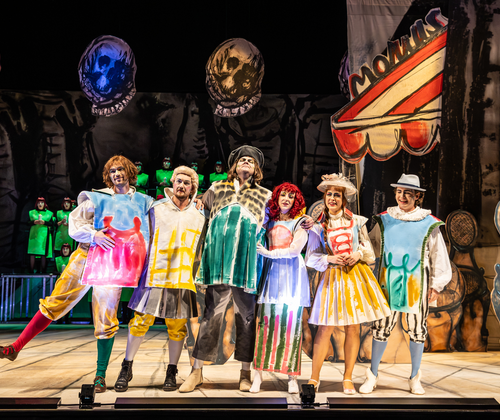
The Meiningen production garnered significant national attention and acclaim. This is because this artist’s opera was brought to the stage by Markus Lüpertz, one of the most important contemporary painters, who—in addition to set and costume design—is also responsible for the direction for the first time. Lüpertz himself lived a bohemian life in his younger years. Anyone who immerses themselves in the art feels the harshness that is part of this existence, he says. He created a stage design like an oversized picture book of enormous visual appeal, into which the characters blend as if with brushstrokes guided by a sure hand. Thus, this opera production is not only a musical delight but also visually unique.