TOURDATA
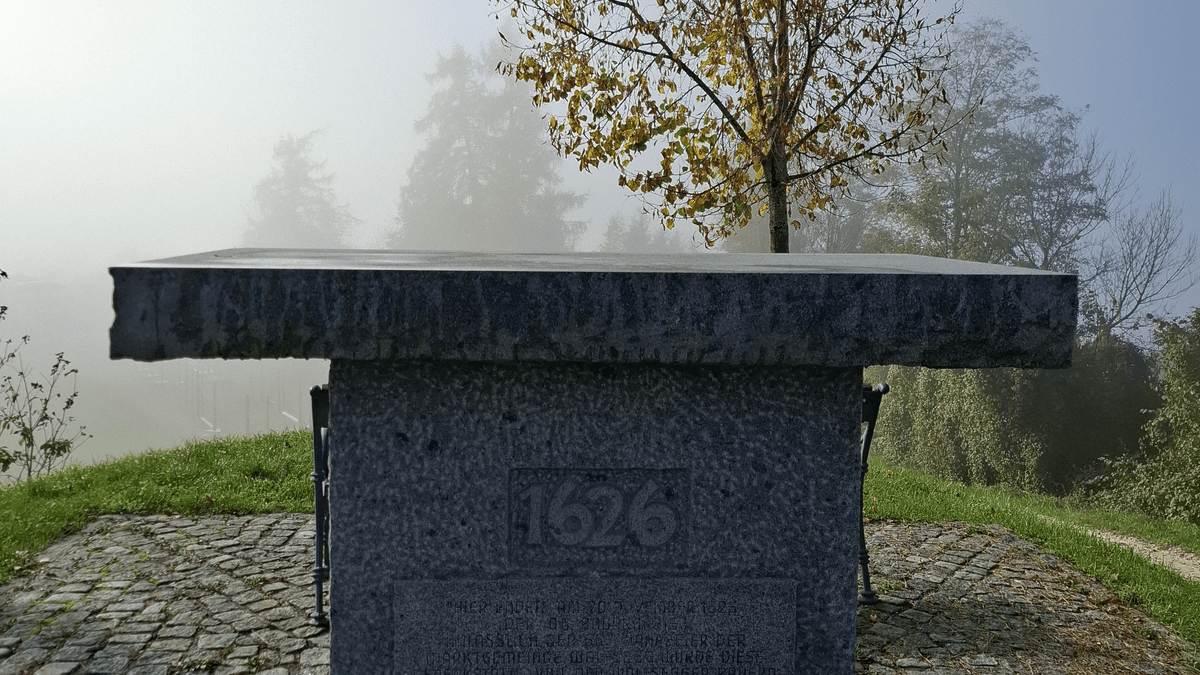
Schanze, 4902 Wolfsegg am Hausruck
OÖ 1626 – A Contested Legacy
The Upper Austrian Peasant War of 1626 resulted from tensions that had built up over the years: political foreign rule, economic burdens, and conflicts over faith. Prior to this, the Frankenburger Criminal Court of 1625 had already condensed these experiences into an event that has been deeply inscribed in the collective memory.
The consequences of the war extended far beyond the military defeat. Repression, pressure on faith, and emigration shaped entire generations – and later became an important part of regional and Protestant memory and identity.
However, the ways in which the Peasant War has been remembered have changed repeatedly: sometimes as an illegitimate uprising, sometimes as a struggle against foreign rule, sometimes as a testimony of faith, later also as a social revolutionary liberation struggle, as a national-religious popular uprising, or as a reminder of tolerance and against violence. The various sites of memory in Upper Austria alone show: history is not a fixed possession but the result of negotiation. Different political and confessional groups have reinterpreted the events and utilized them for their present – up to the present day.
Our series of events invites participants to engage in dialogue about these multifaceted interpretations – openly, controversially, with respectful listening, and with the guiding question:
OÖ 1626: My, your, our history?
After a few short lectures, these will be discussed among the audience and reflected upon together. Musical accompaniment and food and drink will be provided.
Speakers:
Mag.a Renate Bauinger, educator, director of the Protestant Museum OÖ, Rutzenmoos
Stefan Ennser, farmer, Wolfsegg
Kilian Hindelang, Children’s Friends Wolfsegg/Ottnang
Hanna Bauer, student, Wolfsegg
Moderation:
Wilhelm Seufer-Wasserthal