TOURDATA
Hofmark 1, 4981 Reichersberg
Sonia Leimer engages with the conditions and future of our existential spaces in her artistic work. "Space" is a vague and ambivalent concept: there are mental, virtual, and social spaces as well as habitats, architecture, cities, landscapes, or retreats. Our everyday notions of space are also shaped by a popular cosmology that emerged during the "conquest" of outer space in the 1960s and 1970s. The cosmos, the universe itself, is also space. (Letizia Ragaglia)
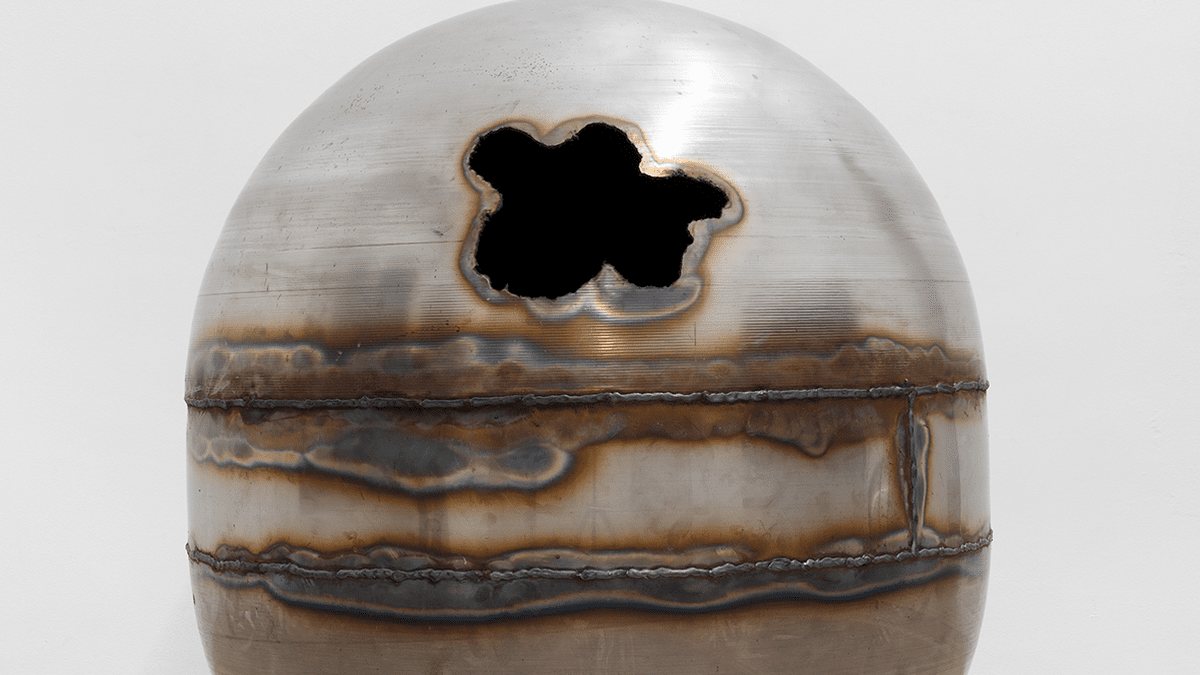
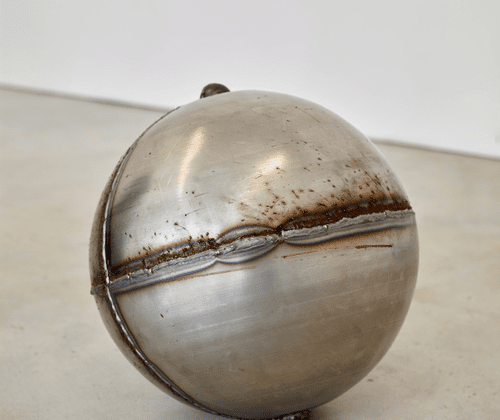
With the sculptures Space Junk, presented at the Galerie am Stein, the artist reflects on how even the infinite expanses of the universe mirror life on Earth and vice versa. Leimer's series of Space Junk sculptures refers to scrap parts from decommissioned satellites and space capsules. In their various sizes and shapes, these objects embody society's desire for progress, while also indicating that radical changes may not be sustainable. On one hand, they point to technological advancement; on the other hand, they compel us to confront the environmental problems that these invisible infrastructures bring with them. Some of the stainless steel objects placed on the ground consist of two hemispheres connected by a cylindrical ring. In contrast to the symmetry of the sculptures with their ribbed, expertly crafted surfaces, the heat-tint colors of the welds and holes that tear open the outer shell reveal a glimpse into the dark interior of the forms. The objects, with their deformations, are testimonies of a change in direction, an unplanned journey shaped by the complex relationship between humans, technology, and nature.
The silkscreens gathered in the exhibition are based on various photographic images of the sun, printed with black acrylic paint on leftover pieces of insulation materials used in the construction of satellites and probes. The work Solar Orbiter shows one such image and simultaneously refers to the research conducted with the satellite of the same name, which aims to better understand the unpredictable behavior of the sun – an endeavor that has so far only allowed us approximations, while its nature remains largely unfathomable. Smiley depicts the "Happy-Face" crater on Mars, whose appearance resembles a smiling face and points to the human attempt to recognize patterns and familiar images in space. The silkscreen 1845 on golden insulation material references one of the first photographic images of the sun from 1845, created by Hippolyte Fizeau and Léon Foucault using the daguerreotype, on which sunspots are already visible. The visual material of the works is linked to the NASA leftover materials used, so that these two forms of approximation – photographic representation and physical material – are brought together into a new spatial experience.
1 Franco La Cecla, Mente locale. Per un’antropologia dell’Abitare, Elèuthera, Milan 1993, p. 15.
Opening hours
| Montag |
- |
| Dienstag |
- |
| Mittwoch |
- |
| Donnerstag |
- |
| Freitag |
- |
| Samstag |
- |
| Sonntag |
- |