Gengenbach
THE Fair in Downtown Gengenbach
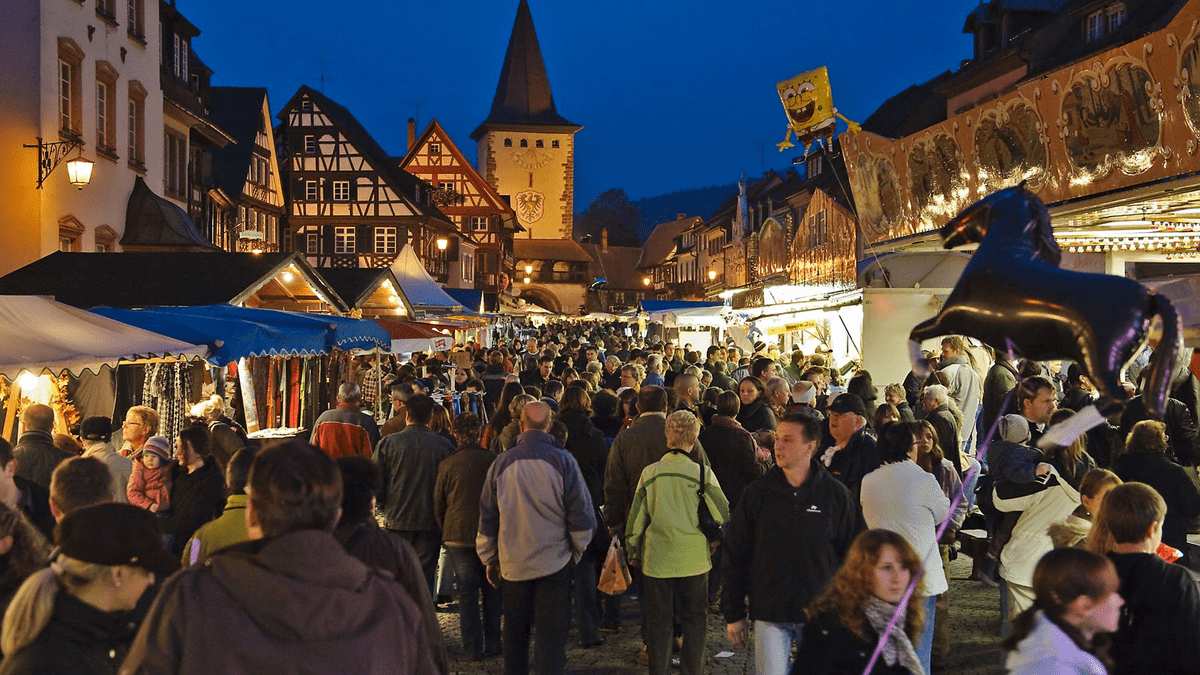
Traditional St. Martin’s Market in the heart of Gengenbach’s Old Town. Vendor stalls, culinary delights, and amusement rides surrounding the historic market square.
Thanks to the Benedictine monastery founded in Gengenbach around 725, so-called annual fairs were already being held as early as the 10th century. They were held in conjunction with church festivals: St. Martin’s, St. George’s, and, for many years, St. John’s.
Vendors included Syrians, Jews, and Venetians.
According to historical documents, markets in Gengenbach are mentioned as early as 1139. Sales took place on the open square in front of the monastery, which is today’s market square. It is reasonable to assume that the town developed as a result of these markets. In the 12th century, efforts were made to attract merchants and tradespeople willing to settle there. A document states that a herald, accompanied by an entourage, announced in all the larger neighboring towns that large two-day markets would be held in Gengenbach on a very large square on St. Martin’s Day, St. George’s Day, and St. John’s Day, and that settlers of good reputation, the Christian faith, and sufficient means—who would not be a burden on the community—were welcome.
The main market, which lasted several days, was held on St. Martin’s Day. Its origins date back to the 10th century, so one can speak of nearly 1,000 years of “St. Martin’s markets.”
In addition to the three annual fairs, a weekly market was soon introduced as well. No farmer in the Imperial City’s territory—that is, Ohlsbach, Reichenbach, Fußbach, Strohbach, Bermersbach, and Schwaibach—was permitted to sell his produce anywhere other than here, nor was he allowed, on pain of punishment, to make his purchases elsewhere.
This shows just how important the markets in Gengenbach were.
In 1650, it was reiterated that any resident of the Imperial City who did not buy or sell at the market—which took place in front of City Hall on the ancient square—would be subject to a heavy fine or imprisonment.
The guilds, which later became so powerful, developed out of market rights and market membership.
The most important aspect of the market was market peace, which was extended to those who visited it to buy and sell. This also included the traveling singers, comedians, and jugglers who appeared at the market. When it was said that the market was at peace, this was to be understood to mean that throughout the entire Imperial City territory, including the subordinate municipalities, the merchants’ freedom to “come and go” to the market was guaranteed, and that in disputes concerning themselves or others, they were permitted to exercise all the judicial authority that had traditionally been granted to merchants.
Along with market rights, customs and coinage laws gradually emerged to protect both sellers and buyers. When it came to protection, the fortified town of Gengenbach was a popular destination. The gates were closed in the evening, and a special guard was provided for the merchants.
Today, the Martinimarkt is a popular gathering place for young and old alike. Former residents of Gengenbach, families, and visitors from the surrounding area come to the town to enjoy the rides, market stalls, and treats around the market square. The Martinimarkt usually takes place on the Wednesday and Thursday before November 11—St. Martin’s Day.