Wien Ticket
Währinger Straße 78, 1090 Wien
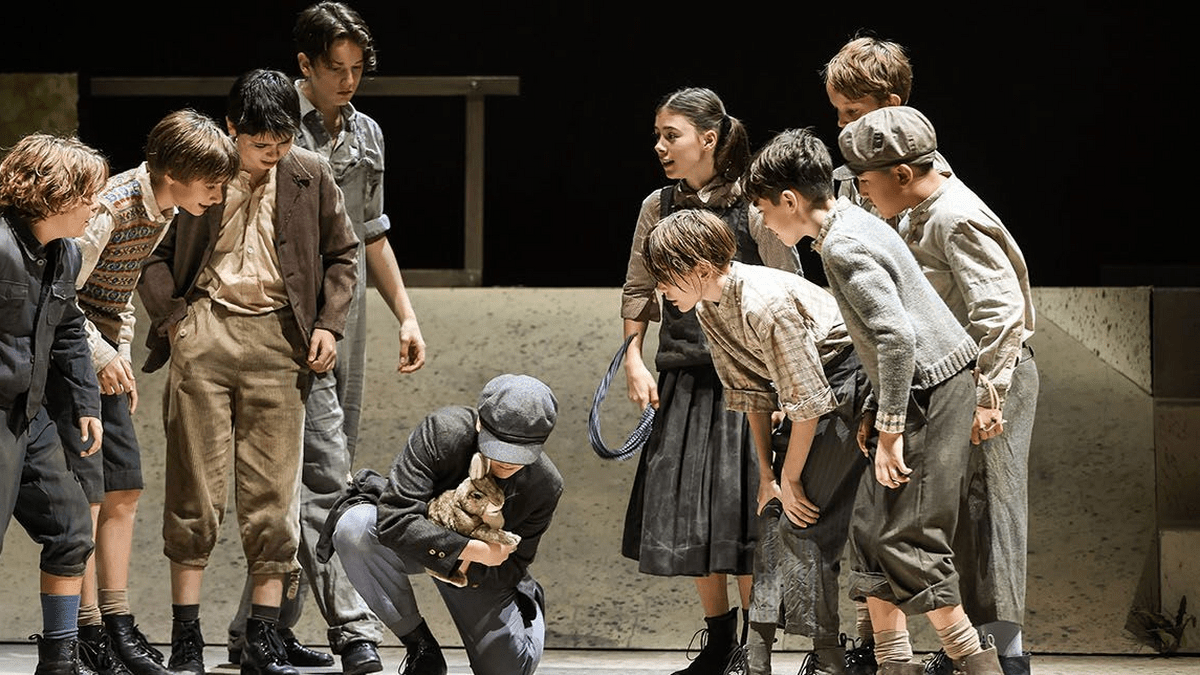
In France 100 years ago: Two small villages have been in conflict for generations, although no one really remembers why. The adults are too busy with farming and the tavern, so it is the children who carry on this fight. They regularly meet in the woods and brawl. Gradually, it seems that getting along becomes more important than fighting against each other. However, when a final confrontation occurs, the fun adventure threatens to turn into bitter seriousness.
"The War of the Buttons," originally a novel by Louis Pergaud, was a great success and has been a staple of French identity since its film adaptation in 1962, as well as a classic of youth literature beyond French borders. The adventure story tells of friendship and enmity, of winning and losing, of small and big children. Johanna Arrouas stages the story with much wit and deep emotions in her own adaptation.
The Bat
Operetta by Johann Strauss
In German with German and English surtitles
Trailer: https://youtu.be/awO6OMfI5sA?si=iNjMaHVfw6wYc1iF
“Happy is he who forgets what cannot be changed!” It is probably the most popular, certainly the most Viennese of all operettas: Johann Strauss' immortal "The Bat." Lavish parties, erotic mix-ups, conspiracies, intrigues, and a large dose of schadenfreude: the pinnacle of the Golden Age of Operetta offers double-edged entertainment in waltz time. And when the social facade begins to crumble, one can always attribute it to the effects of champagne. “In the fiery stream of the vines,” one easily goes overboard.
The Volksoper is considered the most Viennese opera house in the city. Thus, it is not surprising that Johann Strauss' masterpiece is practically regarded as family silver here. No work has been performed more often at the Volksoper. At the beginning of Lotte de Beer’s directorship, the production was carefully refreshed, and a female court servant, Frosch, has since provided a fresh perspective on a well-known piece.
Killing Carmen
by Nils Strunk, Lukas Schrenk, and Gabriel Cazes
In German, French, and English with surtitles
Trailer: https://youtu.be/CD6kC4d05CQ?si=H3etZ1RD8xjfEEdI
“I have been warned that I must fear for my life,” Carmen explains—foreseeing her own doom—in the finale of Bizet’s “opera of all operas” (superlative according to F. Nietzsche). A few minutes later, she is dead, stabbed by her former lover, the soldier Don José. The team behind “Killing Carmen,” consisting of Nils Strunk, Lukas Schrenk, and Gabriel Cazes, has now wondered from which perspective this opera—after its numerous, also pop-cultural adaptations of the 20th century—could be retold once again. The three exceptional artists, who have dedicated themselves to bold and energetic adaptations of classics for several years, continue the story of the opera: What happened after the murder of Carmen? What void does she leave behind?
“Killing Carmen” takes place 13 years after the events of the opera: Don José has been in prison until now and is to be hanged. On the day of reckoning, various characters return to Lillas Pastia's bar and negotiate their different memories once again: one of them has been complicit, one still longs for the former love, and another can look back on a lived life, but perhaps only because she was not the chosen one back then... Where do the characters stand 13 years later? And what does the partially glorified, colorful, and emotion-laden past still mean to them?
In a fast-paced musical and textual reworking, Nils Strunk, Lukas Schrenk, and Gabriel Cazes mix flashbacks and continuations. Bizet's famous melodies encounter various music styles from jazz, flamenco, musical, and pop to country, chanson, and much more. The stylization of the classical Carmen as a notorious "femme fatale" shapes the reception history of Bizet's opera. This also carries the risk of a subtle reversal of perpetrator and victim. Sometimes romanticizing, sometimes demonizing, it subtly assigns her some guilt for her fate. But is that what Bizet and his librettists Halévy and Meilhac really wanted to convey? “I was born free, I will die free,” Carmen proclaims in the finale of the original. Does Carmen die for the way she wants to live? And with her, does freedom itself perhaps die? Every person carries a world within them. When a person is killed, that world dies with them.